
How tranching is becoming allocation infrastructure in DeFi.
Published by Dialectic Meccanico in collaboration with Royco.
In brief:
Any DeFi yield comes with two options: deposit and hold all of its risk, or pass and earn none of it.
Tranching adds a third. It splits the strategy into a protected Senior position and a first-loss Junior position, each priced and held on its own.
Allocators can now stop choosing whole positions and start holding the exact slice of risk they want.
The same strategy then reaches more capital and risk carries a clear price.
Our view is tranching is turning from a product into infrastructure. Below we set out how it works and where Dialectic Meccanico already uses tranching to curate a strategy specific vault.
Splitting out risk into options
A standard DeFi vault offers one risk level. Conservative capital passes, because it eats the full loss if the strategy draws down. Aggressive capital passes too, because willingness to absorb that loss earns them nothing extra.
Tranching splits a single yield into two products, each for a different investor:
Senior, the protected side: drawdown protection down to a set floor, at a lower rate. This is for capital that has to protect principal.
Junior, the paid-to-take-risk side: first in line for any loss, and paid a premium out of Senior’s yield for this.
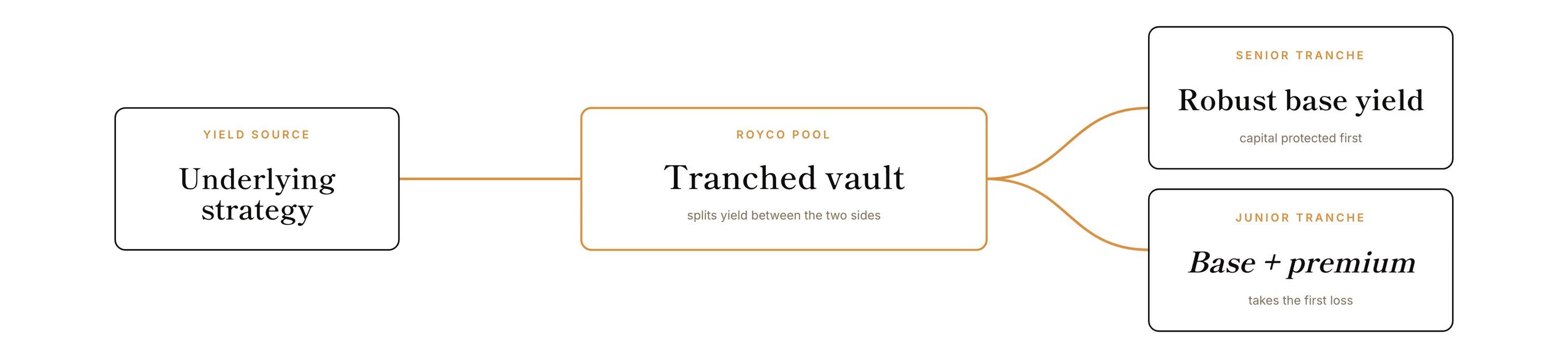
The asset and the strategy underneath do not change, only the risk is repackaged. On Avalanche (at the time of writing) Avant’s savUSD earns about 7.95%, split into a Senior near 7.57% and a Junior near 9.23%, with Senior protected down to a 20% floor. Junior’s extra yield is Senior’s payment for the protection. The same split now runs across many Royco Dawn markets.
Risk gets a price
In a blended vault, the price of risk is buried inside a single APY. Tranching splits it open through two numbers:
The Junior premium rises and falls with demand for first-loss capital.
The protection floor is sized to each strategy, higher for riskier ones, lower for steadier ones. Today it runs roughly 3% to 20% across live Royco Dawn markets.
Together, these numbers tell a curator/allocator what a position’s risk is worth before committing to it.
This clarity is what gives a strategy manager options depending on the mandate:
Capital that must protect principal takes Senior: covered exposure with a defined buffer, underwritten by Junior.
Capital paid to underwrite risk takes Junior: a standalone first-loss product, and with higher yields.
Tranching makes first-loss a product an allocator can actually price and choose.
A Senior vault curated by Dialectic Meccanico
Senior tranching is not a single-market idea. The Senior Royco USDC Vault (srRoyUSDC) already spreads Senior exposure across many Royco Dawn markets.
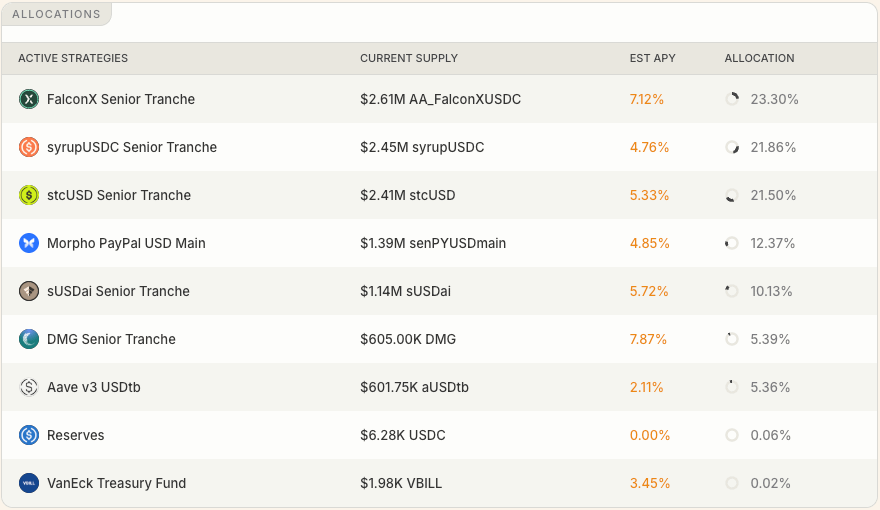
Because the book holds Senior tranches from several different issuers, a problem at any one of them touches only a part, not the whole vault.
Senior is a new kind of collateral
Because Senior carries drawdown protection down to its floor, it is considered less risky than the raw strategy behind it, so a lending market can lend against it at a higher LTV than against that raw asset. Senior becomes its own category of collateral. It supports more borrowing and keeps earning while it is posted as collateral.
For curators like Dialectic Meccanico, that opens a strategy the raw asset never could. Dialectic Meccanico can loop Senior as safer collateral, borrow against it, and redeploy, building a mezzanine layer that is leveraged but sits behind drawdown protection the whole way down. The leverage lifts the return and the coverage limits the downside on each underlying position.
Losses are handled with discipline
For institutions, the way losses are handled decides whether a position can be held at all. Two things matter:
A short drop does not trigger a loss. When a strategy dips, the market enters an Observation Period. Junior only takes a loss if the drop lasts past a set time or goes beyond a set size. A brief dip that recovers does not count.
Pricing follows the real value of the assets and not a temporary market price. So a short-lived dislocation doesn’t force a markdown and the protection floor is enforced by the contract.
From product to infrastructure
Tranching does not care what the strategy is. Any yield-bearing asset with a priceable value can be split, and the live Royco Dawn markets already include credit-backed stablecoins, delta-neutral strategies, and real-world-asset yield.
Royco standardizes the contracts, the protection enforcement, and the premium routing across all of them, so for an issuer, launching a tranched market is a distribution decision and not a rebuild.
The same is true on the curation side. Allocating the Senior Royco USDC Vault across tranched markets is active work, and Dialectic Meccanico does it through Makina’s onchain execution infrastructure, with every permitted action predefined onchain. Royco standardizes the product layer and Makina’s vault infrastructure gives the curator the operational layer to effectively manage the vault.
Why this matters
For decades, only traditional credit markets could slice risk into tranches. Now DeFi can too, but with the pricing in the open and the settlement automatic.
For Dialectic Meccanico as the curator, the payoff is direct. Strategies that were off-limits are now considered for inclusion in a strategy, with their risk priced in plain sight.
This is the whole idea behind risk as a product. Tranching turned risk from something a depositor holds into something an allocator chooses. If the Senior side is the side you’d choose, the srRoyUSDC vault is live.
All vault activity carries risks including smart-contract risk, oracle risk, market risk, liquidity risk, and protocol-governance risk. Past strategy performance is not indicative of future strategy performance. Investments involve risk, including potential loss of principal.
Nothing in this post should be considered investment, tax or legal advice or the recommendation to sell, or the offer of a solicitation to buy or invest in any investment product, vehicle, service or instrument.